
— Executive Summary
At a glance.
Student housing remains structurally undersupplied in 2026. Rents continue to rise, new construction is stalling, and demand is set to increase again by 2040.
+2.6%
Year-on-year rise in student housing rents across Germany, H1 2026
4.0%
Average annual rental growth over three years
€697
Inclusive rent for a model 30 m² flat in Heidelberg – the highest in Baden-Württemberg
€380
BAföG student support housing allowance – sufficient in only one of 38 locations
2/3
Of the university locations surveyed have declining construction activity
What this means for us
For DANKE Campus Group, a subsidiary of GermanLandmarks, current market conditions define a clear role: upgrading the energy performance of existing halls of residence and developing new sites in line with the Green Campus approach.
- Rents: Growth is slowing, but there is no reversal of the trend. Small, self-contained flats are particularly sought after.
- Rhine-Neckar: Heidelberg is one of Germany’s six most expensive university cities; Mannheim is significantly cheaper at €550.
- Supply: The sharp fall in building permits since 2022 is now feeding through into completions.
- Opportunity: The greatest scope lies in existing stock – older residences that can be refurbished, densified and made climate-ready.
Throughout this report, “inclusive rent” means rent including heating and service charges.
— Chapter 1
German market overview.
Pressure on student accommodation persists, even as the pace of rental growth has eased.
Over three years, quality-adjusted student housing rents rose by an average of 4.0% annually, with the latest year-on-year increase at 2.6%. The steepest rises were in precisely the types of accommodation offered by a modern hall of residence.
| Segment | H1 2026 change, year on year |
|---|---|
| Small flats under 40 m² | +3.5% |
| Rooms in shared flats | +2.3% |
| Furnished temporary accommodation | +2.0% |
| Student housing overall | +2.6% |
Wide regional variation
Munich remains the most expensive university location: around €880 for the model 30 m² flat. Berlin, Frankfurt, Cologne, Hamburg and Heidelberg follow at around €700–720. Chemnitz is cheapest at around €280. A 20 m² room in a shared flat costs around €850 in Munich and €220 in Chemnitz.
More listings, little new supply
Visible supply has grown in almost half the locations, including Regensburg, Saarbrücken, Münster, Darmstadt and Bochum. This creates little new accommodation: most of the activity is turnover within existing stock.
BAföG funding gap
The current €380 housing allowance under Germany’s BAföG student support scheme covers the model flat only in Chemnitz. The planned increase to €440 for the summer semester of 2027 narrows the gap but does not close it in high-demand locations.
Our perspective
Operators offering affordable, predictable all-in rents have a clear competitive advantage in this market – for students, parents and funding bodies.
— Chapter 1 · Continued
Housing as a cost factor.
Housing has long been the largest item in students’ budgets – and a factor in Germany’s competitiveness as a place to study.
≈ 54%
Of disposable income is spent on housing by students in their own households (2025)
> 2×
The housing cost share of the population as a whole
≈ 2/3
Of student households are classed as overburdened by housing costs
Markets under pressure
Over three years, rents in some university locations rose considerably faster than the national average of 4.0% a year.
| University location | Avg. annual rental growth, 3 years |
|---|---|
| Hamburg | +5.8% |
| Saarbrücken | +5.8% |
| Bochum | +5.5% |
| Average across all 38 locations | +4.0% |
Choosing where to study by rent
When students have to choose where to study on the basis of affordable housing rather than academic opportunities, Germany becomes less attractive as a centre for higher education and research – for talent from both home and abroad.
Our perspective
Affordable housing strengthens a location’s appeal. Operators that keep inclusive rents low over the long term become strategic partners for universities and local authorities.
— Chapter 2
Focus on Baden-Württemberg.
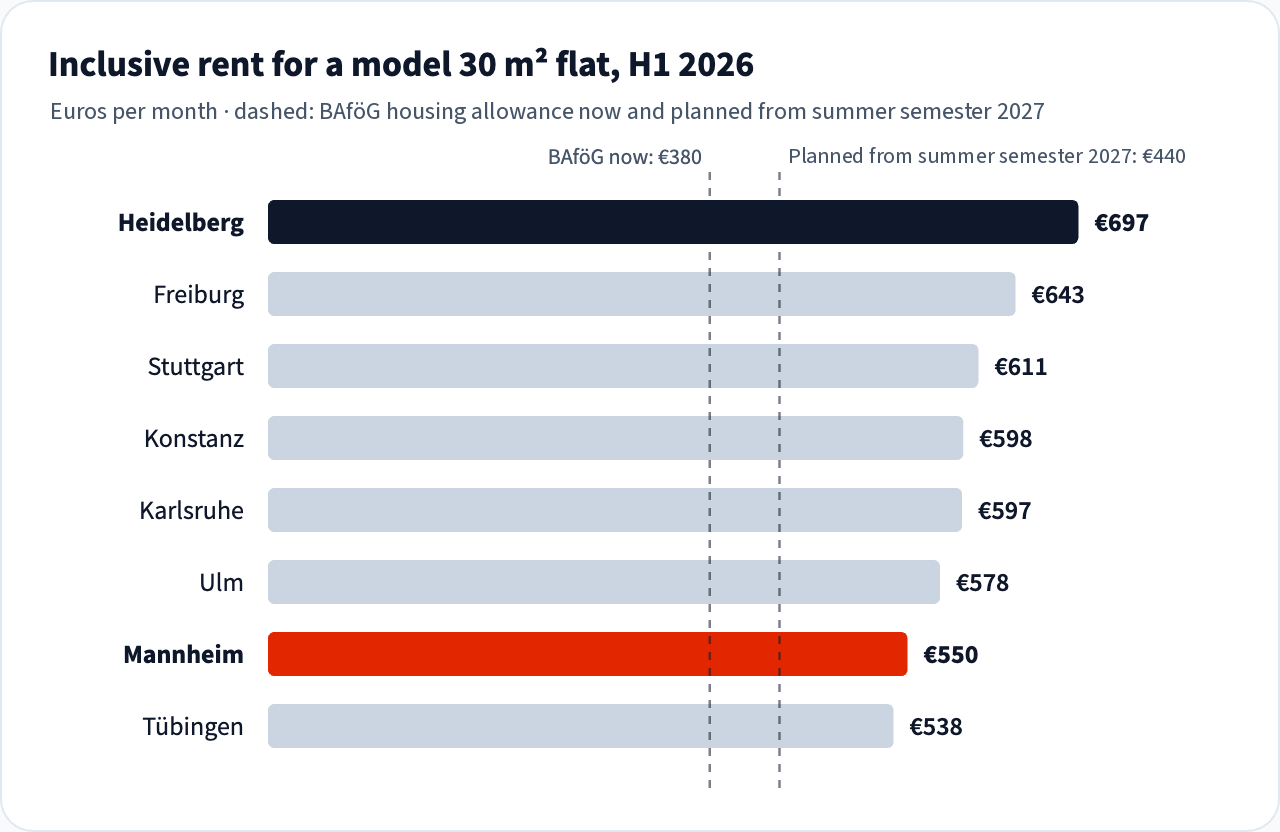
In none of the eight university cities surveyed in the state does the BAföG allowance cover a 30 m² flat.
Diverging trends
The strongest rental growth was in Ulm (+6.7%), Karlsruhe (+4.4%) and Tübingen (+3.9%). Freiburg matched the national average at +2.6%; Stuttgart was the sole exception, at −0.4%.
Shared flats offer little saving
A 20 m² room in a shared flat costs €685 in Heidelberg, €609 in Freiburg, and €559 in both Stuttgart and Konstanz. A self-contained flat in a hall of residence is becoming a genuine alternative.
Smaller locations
Rents are considerably lower in Pforzheim (around €450) and Reutlingen (around €490). The conventional student segment accounts for only around 20% of the market in these locations.
Rhine-Neckar
Heidelberg is a high-price market with limited land availability. Mannheim is around €150 cheaper and offers greater development potential. Together, the two cities form DANKE Campus Group’s core market.
— Chapter 3
Supply gap.
Housing supply will continue to fall short of demand in the years ahead.
For the first time, the 2026 report analysed construction activity across the 38 university locations surveyed. Popular university towns and cities still see above-average building activity, but in many places this is not enough to ease the shortage.
Since 2022
Building permits have fallen sharply – the effects are now becoming visible
≈ 2/3
Of locations have slowing construction activity, in some cases markedly so
2040
Student numbers are forecast to exceed today’s level by this date
Demand is set to return
After a brief dip, student numbers are expected to rise again. For many university locations, this means renewed pressure on housing markets in the years ahead – while new construction is already insufficient.
Now is the time to act
Temporary falls in student numbers in individual locations are not a reason for complacency, but an opportunity. They create breathing space to refurbish residences and add places before demand picks up again.
Our conclusion
Creating capacity now, or securing existing places for the long term, establishes a position in a market likely to become tighter rather than easier over the next decade. We are therefore pursuing two paths in parallel: revitalising existing stock and targeted new development.
“The most sustainable home is often one whose structure already exists.”
— Chapter 4
Green Campus.
Affordable housing that remains environmentally and financially sustainable for decades. Low energy costs are not an optional extra: they are the direct route to stable inclusive rents – and our answer to the BAföG funding gap.
01 Energy-efficient new buildings
We plan new buildings to the KfW 40 standard, with QNG certification (Germany’s Quality Seal for Sustainable Buildings).
02 Climate-ready refurbishment
We upgrade the building envelope, windows, building services and heating systems so that older residences achieve a better energy efficiency rating.
03 On-site renewable energy
Solar PV on roofs and parking areas, heat pumps and, where possible, on-site electricity supply to tenants – drawing on the Group’s energy expertise.
04 Saving embodied energy
Conversion, additional storeys and infill take priority over demolition: rethinking existing buildings rather than sealing more land.
05 Campus as a place to live
Shared spaces, sport, study and start-up facilities, green outdoor areas and cycling infrastructure – rather than simply maximising bed numbers.
We measure performance through energy use per m², inclusive rent per place and occupancy at each location.
— Chapter 5
Revitalising older residences.
The quickest route to more affordable student housing lies in existing stock.
Many halls of residence in Germany date from the 1970s and 1980s and now face a refurbishment cycle that public and non-profit providers can scarcely manage alone. This is where we come in.
Why older residences are so attractive
- Location: Older residences are often close to campus, on sites that are now scarcely available.
- Planning consent: Established student-residence use means conversion and extra storeys are usually faster than new builds.
- Occupancy: Affordable existing rents support high occupancy from day one.
- Environmental impact: Refurbishment saves substantial embodied energy compared with demolition and rebuilding.
Our model for the public sector
We take over existing residences, including under heritable building rights (Erbbaurecht), securing long-term use by students and apprentices. Student services organisations (Studierendenwerke) and councils retain a say in allocations; we provide capital, planning and operation from a single source.
Options for each property
- Comprehensive energy refurbishment to the Green Campus standard
- Optimised layouts with self-contained flats
- Additional storeys or infill on underused land
- Modern services and shared amenities
— Chapter 5 · Case study
Older halls beat the market.
Before revitalisation, a hall of residence in the Rhine-Neckar region offers inclusive room rents below the BAföG housing allowance.
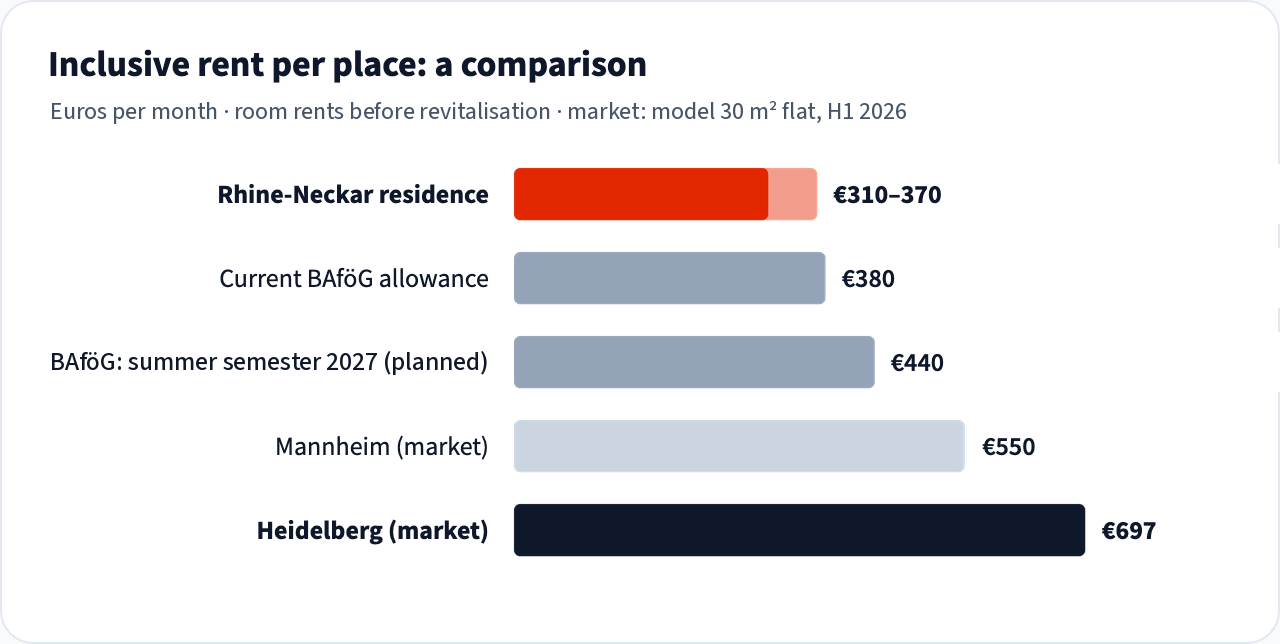
€310–370
Inclusive room rent before revitalisation
≈ 98%
Occupancy rate – high occupancy
≈ €200
Below the model flat in Mannheim (€550)
What this shows
In the hall of residence presented here, inclusive room rents are below the BAföG housing allowance. Affordable accommodation of this kind must be preserved for the long term.
Our model combines both: affordable existing rents for students and financially sustainable long-term operation for owners and partners.
— Chapter 6
Developer and operator.
Development, refurbishment and operation under one roof – with over 18 years of GermanLandmarks’ experience in the Rhine-Neckar property market.
| Component | Status |
|---|---|
| DANKE Campus Mannheim Am Steingarten 12+14 | 241 units, now letting for the winter semester 2026/27 |
| Am Steingarten new development | Planned: student housing with reception, padel, fitness and a start-up hub; KfW 40 QNG standard |
| Acquisitions of existing residences | Further residences in Baden-Württemberg under review and in negotiation |
| Target portfolio by 2030 | Around 2,000 units in Baden-Württemberg and Hesse |
Our home market: Rhine-Neckar
Heidelberg is one of Germany’s most expensive university locations. At a model inclusive rent of €550, Mannheim still offers a marked price advantage. Together, the two cities form one of the densest concentrations of higher education in south-western Germany.
Our advantage
We plan, build and operate ourselves. This gives us control over the entire cost chain – from construction cost planning to service charge accounts – and allows us to sustain affordable all-in rents over the long term.
Student housing remains scarce – and existing stock determines whether it stays affordable.
We invite student services organisations, local authorities, universities and investment partners to join us on this path.
Sources and notes
The market data are based on the MLP Studentenwohnreport 2026 (Student Housing Report) by MLP SE and the German Economic Institute (IW), published on 30 September 2026, and on reporting by dpa-AFX and dpa/lsw. The Student Housing Price Index is based on advertised listings for 38 university locations supplied by Value AG; the housing cost share comes from Germany’s Federal Statistical Office. Rents for the existing hall of residence are figures supplied by the Group (as at June 2026, before revitalisation). Rental figures are calculated inclusive rents for a model 30 m² flat or a 20 m² room in a shared flat. Inclusive rents include heating and service charges; rates of change are quality-adjusted. Assessments and strategic statements reflect the position of DANKE Campus Group.